

The autonomy gap between perception and reality.
A modern vehicle can steer, brake, change lanes, follow navigation and park itself. To a passenger, that can feel close to autonomy. Under the formal responsibility model, however, many of these systems remain driver assistance because the person behind the wheel must continuously supervise the road and take responsibility for the vehicle.
This is the most important distinction in the autonomous-driving debate. The level is not determined by the number of automated features. It is determined by who performs the driving task, who monitors the environment and who must manage failure when the system reaches its limits.
Autonomy is fundamentally a transfer of responsibility – not simply an accumulation of features.
The six levels of driving automation
SAE International defines six levels, numbered 0 through 5. Transport Canada and the U.S. National Highway Traffic Safety Administration use the same framework to explain the division of responsibility between the human and the automated system.
Level |
What the system does |
Who remains responsible |
0 – No driving automation |
Warnings or momentary interventions may assist, but the human performs the driving task. |
Human driver |
1 – Driver assistance |
The system can support either steering or speed and spacing. |
Human driver monitors and drives |
2 – Partial automation |
The system can control steering and speed together under defined conditions. |
Human driver continuously supervises |
3 – Conditional automation |
The system performs the driving task within a defined operating domain and requests human takeover when needed. |
System drives; fallback-ready human must respond |
4 – High automation |
The system performs the driving task and manages fallback within a limited operating domain. |
System within its operating domain |
5 – Full automation |
The system can drive under all road and environmental conditions that a human driver could manage. |
System everywhere; no human driver required |
Three systems, three different models
Tesla: sophisticated assistance, active supervision
Tesla Full Self-Driving (Supervised) can navigate routes, steer, change lanes, turn and respond to surrounding traffic. Tesla is equally clear that the current features require active driver supervision and do not make the vehicle autonomous. Under the SAE responsibility model, this places the system in Level 2: the software may control steering and speed, but the human remains responsible for monitoring and intervention.
This point is especially relevant in Canada, where increasingly capable Teslas are common on public roads. Capability can look like autonomy from the passenger seat, but the legal and operational responsibility remains with the driver.
Mercedes-Benz: conditional automation inside a narrow domain
Mercedes-Benz DRIVE PILOT illustrates Level 3. When the system is active within its approved operating conditions, it performs the driving task and the person may turn attention away from continuous road monitoring. The driver must remain available to resume control when requested.
The operating conditions matter: approved road segments, speed limits, traffic conditions, weather and vehicle state define when the system can be used. Mercedes-Benz also emphasizes redundant braking, steering, electrical systems and multiple sensor types. Level 3 is therefore not “hands-free Level 2.” It represents a different allocation of responsibility within a tightly controlled operating domain.
Waymo: no human fallback inside the service area
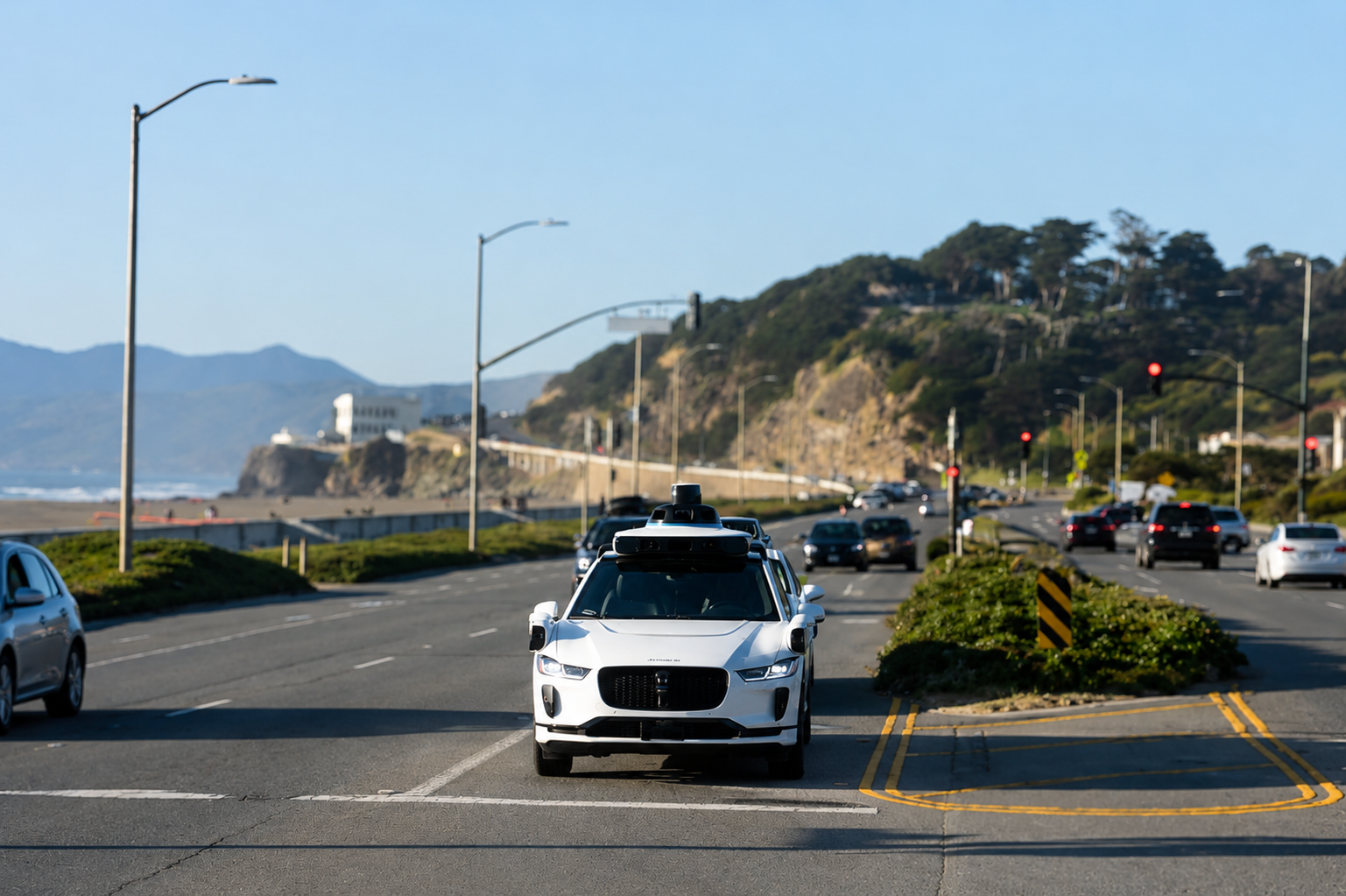
Waymo operates rider-only autonomous services in multiple U.S. metropolitan areas. Within its approved service areas and operating conditions, the Waymo Driver performs the driving task without a human safety driver. This fits the Level 4 model: the automated system is responsible within a defined operational design domain, even though it cannot drive everywhere under every condition.
This explains an apparent paradox. A robotaxi operating in a mapped service area may be more automated than a privately owned vehicle that can travel almost anywhere. Geographic and operational limits can make higher autonomy achievable sooner because the system can be designed, tested and monitored for a narrower environment.
Vision, radar and lidar: different ways of seeing the road
Autonomous systems must continuously detect the road, vehicles, pedestrians, signs, signals and unusual events, then predict what may happen next and plan a safe response. Companies differ on how much sensing diversity is required.
Technology |
What it contributes |
Trade-offs |
Cameras |
Rich visual detail for lanes, signs, traffic lights, objects and context. |
Performance depends on visibility, lighting, cleanliness and interpretation. |
Radar |
Reliable distance and relative-speed measurement, including in some difficult weather. |
Lower semantic detail than cameras; interpretation and integration still matter. |
Lidar |
Precise three-dimensional geometry and depth using laser pulses. |
Adds cost and hardware complexity, although both continue to improve. |
Maps and localization |
Detailed prior knowledge of roads, geometry and expected driving context. |
Maps must remain current and can constrain the operating area. |
AI compute and software |
Combines sensor inputs, predicts behaviour and plans the vehicle’s path. |
Requires extensive validation for rare events, changing conditions and system limits. |
Tesla has emphasized a camera-led vision strategy supported by neural-network processing. Waymo uses a multi-modal suite combining cameras, imaging radar and lidar. These approaches reflect different assumptions about scale, redundancy, cost and the level of operating-domain control. The market has not yet converged on a single universal architecture.
Why Level 4 may scale before Level 3 becomes ordinary
At first glance, Level 3 should arrive before Level 4 because the number is lower. Commercial deployment is not that linear. Level 3 asks a difficult human-factors question: can a person disengage from monitoring and then reliably retake control when the system reaches a limit? The transition itself can become a safety-critical event.
Level 4 can avoid that handoff by asking the automated system to manage fallback – but only within a narrower environment. A fleet operator can define service boundaries, control maintenance, monitor vehicles remotely, update maps and suspend operations when conditions exceed the system’s capabilities. That operating model is difficult to reproduce across every privately owned vehicle and roadway.
Where Canada stands
Canadian consumers already use many Level 0-2 functions, including automatic emergency braking, adaptive cruise control, lane support and supervised automated driving features. Higher automation is developing through federal safety guidance, provincial rules and controlled testing rather than broad consumer availability.
Transport Canada emphasizes clearly defined automation levels and operational design domains, safe responses when limits are exceeded, cybersecurity, data recording and post-deployment monitoring. Ontario has also introduced a ten-year pilot for approved automated commercial motor vehicles running from 2025 to 2035. The direction is clear: more capable systems are coming, but deployment will be conditional, evidence-based and jurisdiction-specific.
Autonomous driving is an AI governance case study
The road to autonomy demonstrates why advanced AI cannot be governed as a software feature alone. The system combines models, sensors, maps, infrastructure, human behaviour, maintenance, regulation and real-time decisions with physical consequences.
Define the operating domain
Specify where, when and under what road, weather, speed and traffic conditions the system is designed to operate. |
Make responsibility explicit
Clarify what the system controls, what the human must monitor, and what happens when the system reaches a limit. |
Validate the long tail
Test rare combinations of events, vulnerable road users, construction, emergency vehicles and degraded sensors. |
Design safe fallback
Plan how the vehicle reaches a minimal-risk condition when the system or the human cannot continue. |
Monitor after deployment
Use incidents, near misses, disengagements, overrides and field performance to improve the system and controls. |
Govern the data and supply chain
Manage training data, simulation, maps, model changes, sensors, cybersecurity and third-party components. |
Executive perspective
The closer an AI system moves from recommending an action to taking one, the more explicit its operating boundaries, accountability and fallback controls must become. Autonomous vehicles make that principle visible, but the same lesson applies to AI agents, financial decisions, health care and other high-impact systems.
Key takeaways
- SAE defines six levels of driving automation, from Level 0 through Level 5.
- Levels 0-2 remain human-driven; at Levels 3-5, the automated system performs the driving task when engaged.
- Tesla FSD (Supervised) is not Level 3 autonomy because the driver must continuously supervise and remains responsible.
- Mercedes-Benz demonstrates constrained Level 3, while Waymo demonstrates Level 4 within defined service areas.
- Cameras, radar and lidar provide different information; autonomy depends on the complete system, not a single sensor.
- Progress will depend as much on governance, validation and operating models as on model capability.
Primary sources and further reading
- Transport Canada – Canada’s Safety Framework for Connected and Automated Vehicles 2.0
- Transport Canada – Guidelines for Testing Automated Driving Systems in Canada
- NHTSA – Automated Vehicle Safety and Levels of Automation
- Tesla Canada – Full Self-Driving (Supervised)
- Mercedes-Benz – DRIVE PILOT Level 3
- Mercedes-Benz – DRIVE PILOT up to 95 km/h in Germany
- Waymo – The Waymo Driver
- Waymo – Service locations and rider information
- Ontario – Automated Commercial Motor Vehicle Pilot Program